The tenth day, after the nine nights of Navratri, which begin around 11 October 2026.
Dussehra Worksheets for Kids
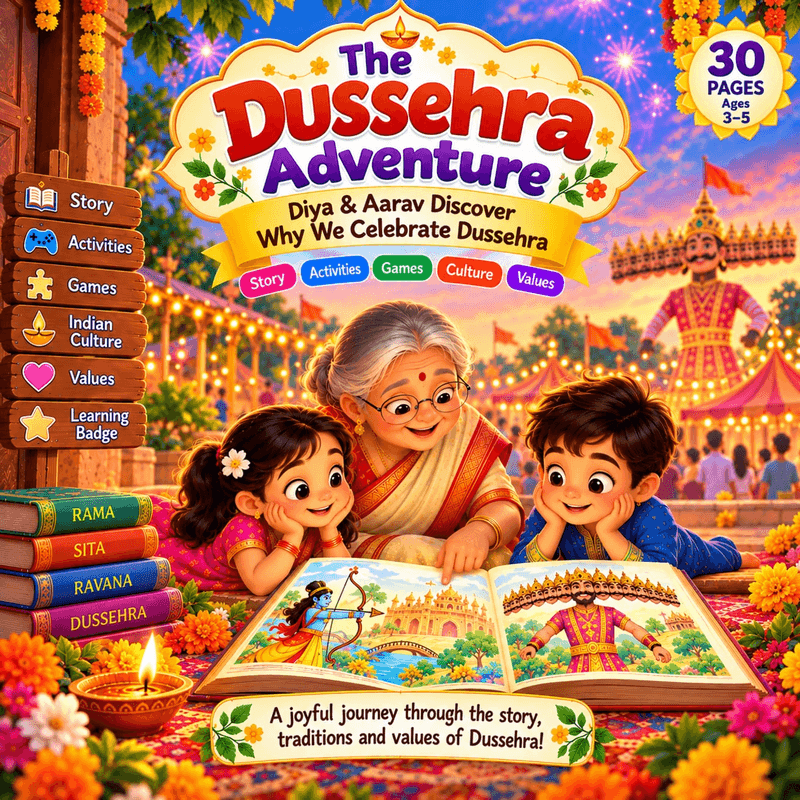
An illustrated Dussehra story and activity book for children aged 3 to 5. Thirty pages follow Diya and Aarav as their grandmother tells them why we celebrate Dussehra — Rama and Sita, the forest, Hanuman, and Ravana — with puzzles, sequencing and dandiya steps built into the story rather than bolted on after it.
- 31 printable pages
- Ages 3–8
- A4 and US Letter
- Black and white — no colour printer
A story, not a pile of worksheets
Thirty illustrated pages with Diya, Aarav and their grandmother running through the whole book. The Ramayana is told a scene at a time — the forest, Sita taken, Hanuman's help, Ravana defeated — in a few sentences a three-year-old can follow, with the grandmother answering the questions children actually ask.
Activities inside the story
Each scene carries something to do that belongs to it: putting the forest pictures in order, working out which shield is Rama's from three clues, copying dandiya steps. The activity is about the page it sits on, so a child is thinking about the story rather than filling in a worksheet that happens to be nearby.
Culture and values, without the lecture
Dandiya, the effigy, why families gather — and underneath, courage, helping friends and telling the truth. Carried by what the characters do rather than stated at the child, which is the only way any of it lands at this age.
Printing it
Thirty-one pages on A4, full colour, with a learning badge to finish. Print the whole thing as a book for the Navratri week, or a few pages an evening. Once it is yours, print it as often as you like.
Who you will meet in the story
About Dussehra
Children ask while they are working. Short answers you can give at the table, alongside the dussehra worksheets.
What is Dussehra?
Dussehra, also called Vijayadashami, falls on the tenth day after the nine nights of Navratri. Across India it marks the same idea in different stories: good coming through against something much larger than itself. Effigies of Ravana are burned in the north, Durga is carried to the water in Bengal, and in the south tools, instruments and schoolbooks are laid out and blessed.
Why do we celebrate Dussehra?
In most of India it marks the day Rama defeated Ravana and brought Sita home — the story this book tells. In Bengal and the east it is Durga's victory over Mahishasura, which is why Durga Puja ends on the same day. Both are the same shape of story, and both end with the idea that courage and truth outlast force. Twenty days later, Rama reaches Ayodhya, and that is Diwali.
The day children begin learning
In Tamil Nadu, Kerala, Karnataka and Andhra Pradesh, Vijayadashami is traditionally the day a child is first taught to write — Vidyarambham, the beginning of learning. A grain tray is prepared and the child traces their first letters in it, hand guided by an elder. If you have ever wondered when to start a three-year-old on letters, this is the day the calendar suggests.
How to explain Dussehra to a young child
A story works better than an explanation, which is why this book is one. Rama's wife was taken, his friends helped him, he was brave, and he won. Three or four-year-olds hold that easily. The burning effigy makes sense once they know the story, and not before — so tell the story first.
When is Dussehra?
In 2026, Dussehra falls on Tuesday 20 October, the tenth day of Navratri, which begins around 11 October. It follows the lunar calendar, so the date moves each year, and it always lands about twenty days before Diwali.
Dussehra worksheets — common questions
When is Dussehra in 2026?
Tuesday 20 October 2026. It is the tenth day of Navratri, which begins around 11 October, and falls about twenty days before Diwali.
What age is this Dussehra book for?
Three to five. The story is told in short sentences, and the activities need no reading — ordering pictures, spotting clues, copying movements.
Is it a story book or an activity book?
Both, and that is the point. Thirty pages of illustrated story with the activities built into each scene rather than collected at the back.
Do I need a colour printer?
The pages are full colour illustrations, so colour printing shows them at their best. They remain readable in greyscale if that is what you have.
What is Vidyarambham?
The tradition, mainly in southern India, of a child being taught their first letters on Vijayadashami — tracing them in a tray of grain with an elder guiding their hand. It is why Dussehra is associated with starting to learn.